Project FootTraffic: A Real Estate Boom for Small Business
I keep seeing the same plaza.
A nail salon. A taekwondo school. An alterations shop. A cafe that is good enough to become somebody's Saturday ritual, but not designed like one. A business with real customers, real utility, and a digital presence that feels like it was assembled between appointments.
Project FootTraffic is the idea that we treat that plaza like real estate.
Not because we own the buildings. Because we can raise the value of the place.
The internet made every small business look like a template. AI creates a chance to do the opposite: take the quality bar of high-end brand, product, service design, and operations work, then bring it to the businesses that were never priced into that level of attention.
The opportunity is not one website. It is not one logo. It is not one booking flow.
The opportunity is the whole plaza.
The Real Estate Model
Real estate agents understand territory.
They know the neighborhood. They know the comps. They know which corner has momentum, which building is underpriced, and which owner needs help seeing what the asset could become.
That is the model I keep coming back to.
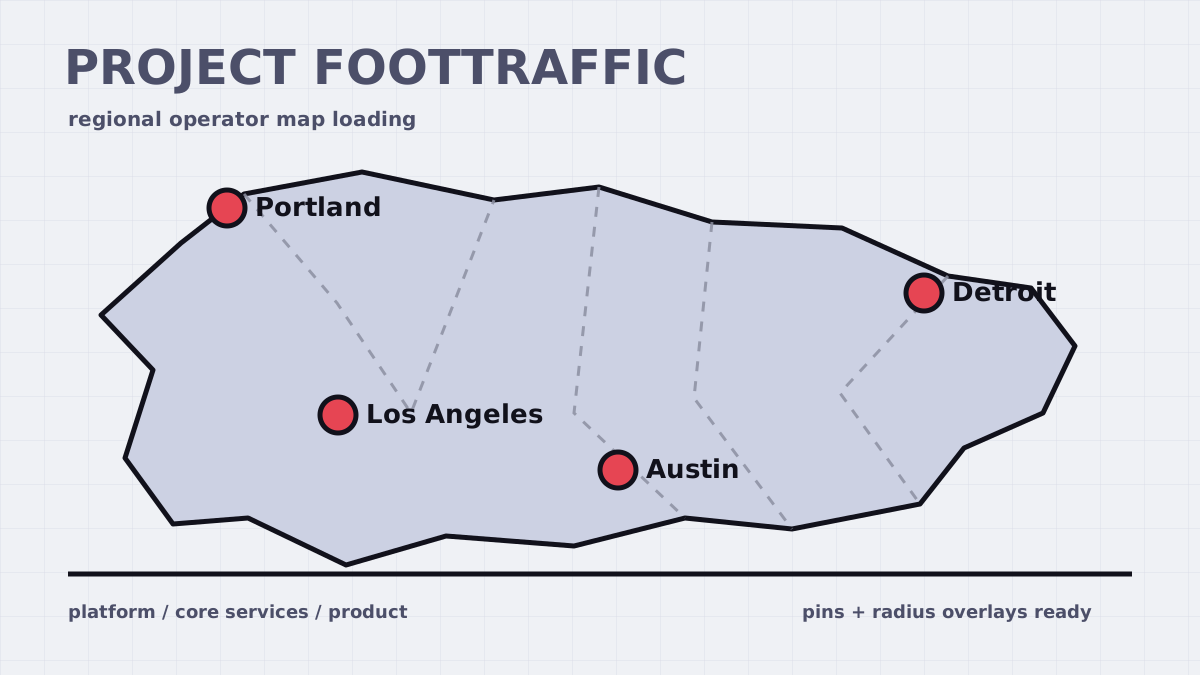
Project FootTraffic would operate like a set of real estate agents for brand and service design. Each operator owns a region. I can work Portland. Marcus can work LA. Jason can work Austin. Alex can work Detroit.
Regional Operator Map
A first pass at the territory model: one operator per region, with the same map module ready for later heat-map and blast-radius layers.
The work starts by finding overlooked clusters with real local demand:
- plazas with multiple service businesses
- tenants with weak digital presence but strong offline utility
- places where one upgraded business would make the next upgrade easier to sell
- corridors where the physical experience is useful, but the brand experience is underdeveloped
The pitch is not "buy a website from us."
The pitch is: your business is part of a place, and that place can become more valuable.
If one tenant improves its identity, booking, checkout, loyalty loop, signage, and customer communication, the neighboring tenants feel the pressure. If three tenants improve, the plaza starts to read differently. If the whole plaza improves, the area becomes a destination.
That is the boom.
The Company Shape
The company has three layers.
Platform is the operating system underneath the work. The CRM. The lead engine. The shared component library. The deployment system. The analytics layer. The AI workflows. The internal monorepo where everything useful gets captured and reused.
Core services are the things a great agency can do in its sleep: brand strategy, identity, web, content, campaigns, local SEO, photography direction, signage systems, menu systems, customer journeys, launch plans.
Product is where the compounding starts to get serious. A booking tool. A quoting flow. A point-of-sale extension. Inventory management. A loyalty system. A staff dashboard. A kiosk. A tiny app that only one alteration shop needed at first, then every alteration shop we meet after that suddenly needs too.
The structure matters because every client can add a module to all three layers.
A logo system improves the service layer. A reusable booking flow improves the product layer. The way we sold, priced, deployed, measured, and supported that work improves the platform layer.
Every job should leave the company more capable than it was before.
The Funding Loop
This is the part that makes the model interesting.
We do not start by raising a giant round so we can disappear for eighteen months and build a platform in the abstract. We let the market fund the platform through real work.
If a business needs something, and the margin makes sense, we build it.
The client pays because they need the outcome. We price the job so it covers the work. Then we make the useful part reusable. The next version gets faster. The third version gets cheaper. The tenth version starts to feel like software.
That means the company compounds in two directions at once:
- revenue comes from services and productized work now
- margin improves as repeated needs become shared modules later
This is why I do not want to frame the company as "we beat Squarespace" or "we beat Shopify" or "we beat Square."
Sometimes the right answer is to use those tools. Sometimes the right answer is to wrap them. Sometimes the right answer is to replace one narrow part because the local business has a workflow the generic tool does not respect.
The point is not to be anti-tool.
The point is to own the judgment layer.
Why AI Changes The Math
The old version of this business is an agency.
The new version is an AI-assisted regional operating company with a product memory.
AI changes the cost and velocity of the work. It lets one good operator do more analysis, more prototyping, more writing, more design exploration, more engineering, and more support than that operator could have done alone.
But the AI only becomes valuable if it is connected to a real compounding system.
Every plaza teaches us. Every business teaches us. Every weird edge case becomes a prompt, a pattern, a component, a schema, a checklist, a sales objection, a dashboard, a reusable service package.
The AI grows because the company grows.
It learns the difference between a nail salon that needs better booking and a taekwondo school that needs parent communication. It learns which offers convert. It learns which before-and-after stories move a landlord. It learns which POS limitations are tolerable and which ones are quietly killing margin.
That is the part that feels new: not AI as a demo, but AI as the layer that makes high-end service design operationally possible for businesses that could never afford a traditional version of it.
Feasible, Viable, Desirable
The feasibility comes from starting with what we already know how to do.
We can build the digital layer. We can design the brand layer. We can talk to customers. We can write the copy. We can make the website. We can launch the campaign. We can wire the tools together. With AI, the surface area one person can responsibly cover gets much bigger.
The viability comes from the funding model.
The work is not speculative if clients are paying for the first version. The company does not have to guess at all of its modules up front. It can discover them through margin, repetition, and demand. If three businesses in three cities need the same thing, that is no longer a one-off. That is a product signal.
The desirability comes from the physical world.
People still go places. They still get haircuts, take classes, pick up food, fix clothes, visit studios, buy gifts, and bring their kids to lessons. Most local businesses are not suffering because nobody needs them. They are suffering because the experience around them is under-designed.
Project FootTraffic exists to close that gap.
The Team Model
This does not work as a centralized agency waiting for inbound leads.
It works as regional ownership.
I want the team to feel closer to agents than account managers. Each person knows their market, sells their territory, identifies the right clusters, and brings back repeatable needs to the shared system.
Portland can teach LA. LA can teach Austin. Austin can teach Detroit. Detroit can teach Portland.
The company becomes national because the learning is shared, not because every decision comes from one central office.
That is also how the sales story gets sharper. We are not walking into a small business with generic software. We are walking in with proof from similar places, similar constraints, and similar customers.
A Portland Version
The first move is not glamorous.
I would map the city.
Find the plazas. Find the clusters. Look for businesses with strong local utility and weak experience design. Score them by foot traffic potential, tenant density, category repetition, digital weakness, and owner accessibility.
Then pick one plaza and sell the first wedge.
Maybe it starts with a nail salon that needs a better identity, a better booking flow, better local search, and a cleaner post-visit retention loop. Maybe the taekwondo school next door needs parent onboarding, class scheduling, trial offers, and event communication. Maybe the alterations shop needs quoting, intake, photo upload, pickup reminders, and a way to stop losing context in text messages.
Each of those looks like a service project.
Underneath, each one is a module.
The plaza becomes the first case study. The before-and-after matters. The photography matters. The signage matters. The web traffic matters. The booking conversion matters. The owner quote matters. The customer story matters.
Then the next sale is easier.
The Investor Pitch
Project FootTraffic is a real estate boom for small and medium businesses.
We transform overlooked local plazas into destinations by combining regional sales, high-end service design, AI-assisted execution, and a compounding product platform. Each business funds the solution it needs. Each solution becomes a reusable module across platform, core services, and product. As the modules compound, our cost goes down, our velocity goes up, and our ability to serve the next plaza gets stronger.
We are not trying to sell a generic template to every local business.
We are building the operating layer for the places people already go.
The digital work gets us in the door. The physical experience makes the transformation visible. The platform makes it scale.
What Is Missing
The idea still needs proof.
Not more pitch language. Proof.
The first proof is one plaza. One clear before-and-after. One paid engagement where the client funds a useful module and the module survives the project. One story where the business owner can say, plainly, that more people came in, more people booked, more people returned, or the work got easier to run.
The second proof is repetition. If the same need appears in Portland and Austin, it is not a coincidence. If it appears in LA and Detroit too, it is a product line.
The third proof is operator leverage. Can one person manage a hundred small businesses with the right AI, tooling, and service architecture? That is the real question. Not whether one person can make one good website. Whether one person can operate a territory.
That is the company hiding inside the idea.
Brick By Brick
The rollout is simple enough to say out loud.
Analyze the area. Find the right plaza. Sell the first business. Build the first solution. Capture the reusable module. Show the result. Sell the neighbor. Improve the system. Repeat.
Brick by brick.
At the small end, that might be business cards, signage, a homepage, a booking form, and better follow-up texts.
At the large end, it might be a full POS system with inventory, staff workflows, loyalty, and analytics.
The range is the point. The company should be willing to go as deep as the margin and the learning justify.
That is Project FootTraffic: a way to build a big technology company through the overlooked physical spaces of everyday life.
Not by replacing local businesses.
By making them impossible to ignore.